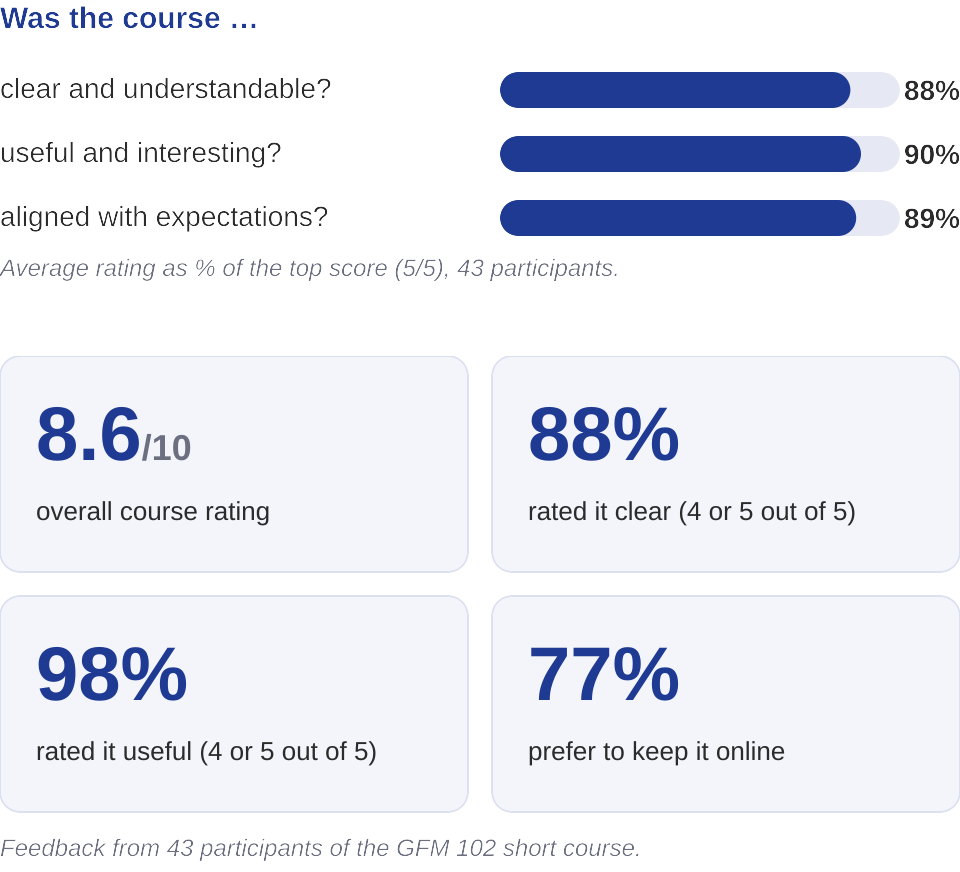
UNIFI Short Courses are engaging and practical programs designed for those interested in gaining a strong foundational understanding of key concepts in inverter-based resources (IBRs) and grid-forming (GFM) technologies. Filled with real-world case studies and organized as interactive modules, these courses cover a wide range of topics and will meet your needs whether you are new to this space and seeking a fundamental understanding of power grids and grid-forming inverters, or you are a seasoned professional seeking to elevate your skills and optimize your knowledge base. CEUs are offered upon course completion. Stay tuned for our next offering!

GFM 101: Fundamentals

This course covers the fundamentals of the power grid, feedback controls, grid-following inverters, and grid-forming inverters. It is intended to be a first look at all things grid-forming and an avenue to get acquainted with basics in modeling, simulation, control, and analysis. Beginning with a detailed discussion on DC/AC power conversion, the course builds up to provide an intuitive understanding on why GFM IBRs can reduce reaction time to smooth out grid disturbances, improve grid stability, and provide the ability to help restore the grid from adverse operating conditions.

Course length: 5 sessions, 2 hours each, 4 modules. Total duration 10 hours.

Course includes: Lecture slides (sample below), pen-&-paper exercises, short quizzes, and simulations

Last offered: Fall 2025

Module 1

We begin with an overview of the power grid, from its historical foundations to future developments. It introduces how electricity is generated, transmitted, and distributed, along with the basic principles of synchronous generators, AC waveforms, and inertia. It also explores how inverter-based resources differ from traditional synchronous generators, introduces DC voltage conversion, and covers the fundamentals of DC-AC inverters, including pulse width modulation (PWM). EMT Exercise: Implement PWM in elemental half-bridge setup; illustrating in a simulation environment how it is possible to make AC from DC by means of switching.

Module 2

This module provides an overview of feedback control relevant to inverter-based resources. It begins with an overview of control systems and how controllers can be designed to achieve tracking with zero steady-state error. It also covers the fundamentals of simple proportional-integral (PI) control and introduces the concept of reference frames for modeling and control. EMT Exercise: Add current control feedback loop around the IBR with PWM, and explore how the bandwidth setting changes the speed of the current control. Explain and show step response, steady state tracking.

Module 3

This module introduces the technology of grid-following inverters. Central to the operation of grid-following inverters are phase-locked loops (PLLs) that aid in synchronizing such inverters with the electrical grid. The module explores the advantages and disadvantages of grid-following inverters, along with their practical applications and real-world examples to illustrate their use in power systems. EMT Exercise: Connect PWM with current loop to a grid. Show that it becomes unstable when in island or when grid connection becomes too weak.

Module 4

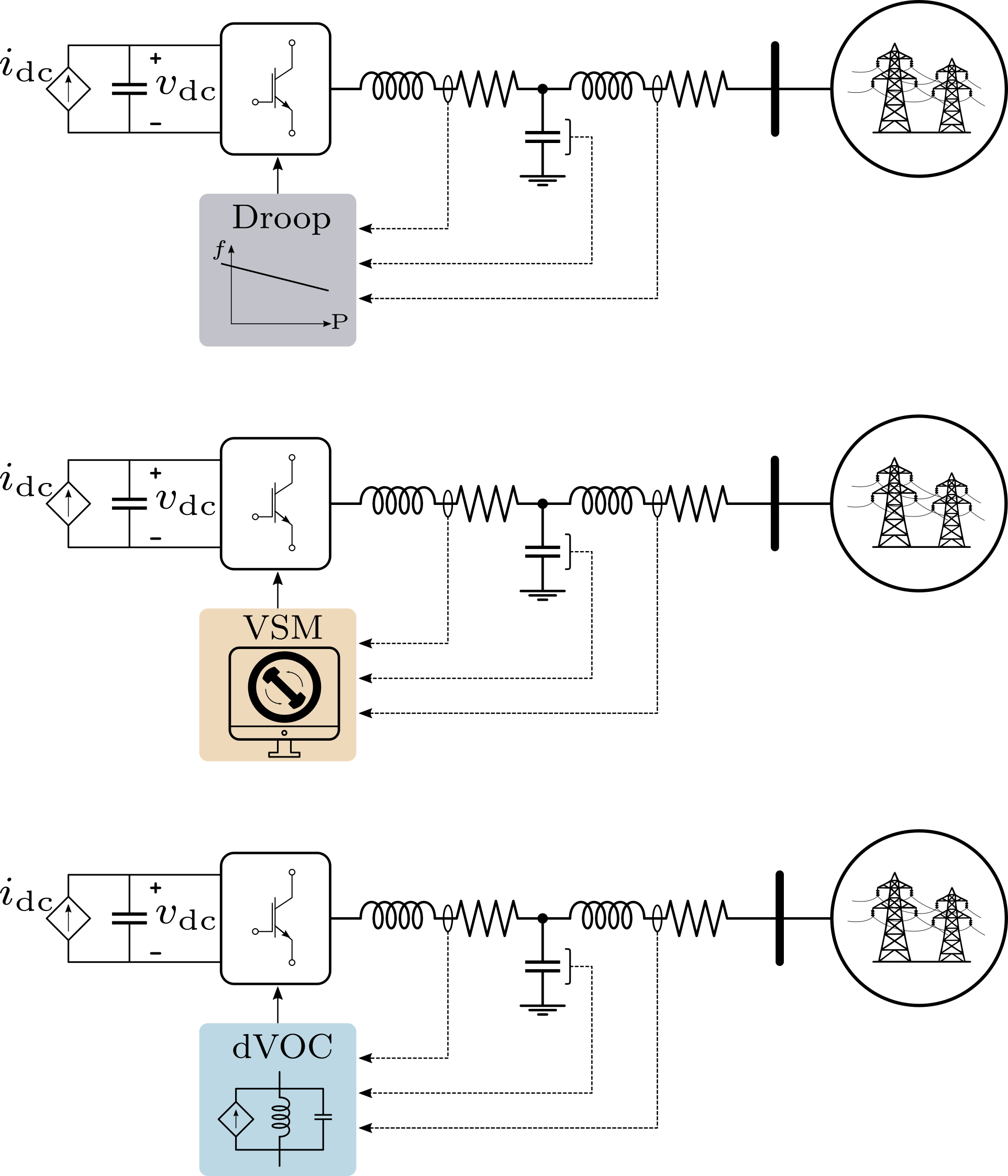
The final module introduces the concept of grid-forming inverters. A detailed examination is provided on how they enable power sharing without relying on a phase-locked loop (PLL); much like conventional synchronous generators. The module also provides a conceptual overview of how different grid-forming control strategies operate and examines their practical applications through real-world examples and use cases in modern power systems. EMT Exercise: Navigating through a full generic GFM inverter Illustrate islanding mode (the distinct benefit of a GFM inverter). A simple interconnection study for a single-inverter infinite-bus system.

Testimonials

"It has been awesome. You guys remind me why I love power systems so much. You explain everything at a really good pace. I love the idea to have two presenters. This could be a difficult topic to digest so having two people helped to present the ideas in two different ways."

"Definitely keep this as an informal “office hour” feeling event. That was great. Even though I didn’t have a ton of questions, it was helpful to hear other questions and the answers."

"Quality was great, but I wish it was a bit longer."

"This was a great course and very interactive. In the online format, I would continue to encourage use of webcams for everyone to support the
speakers."
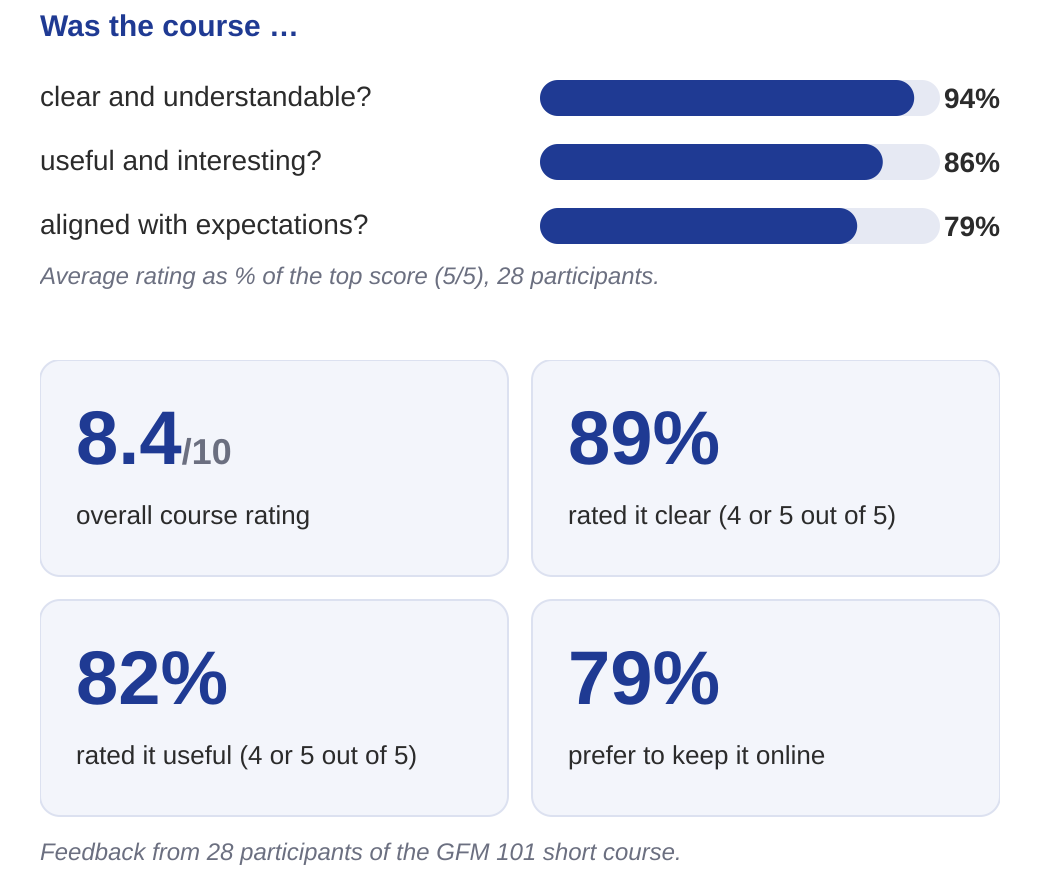
GFM 102: Stability
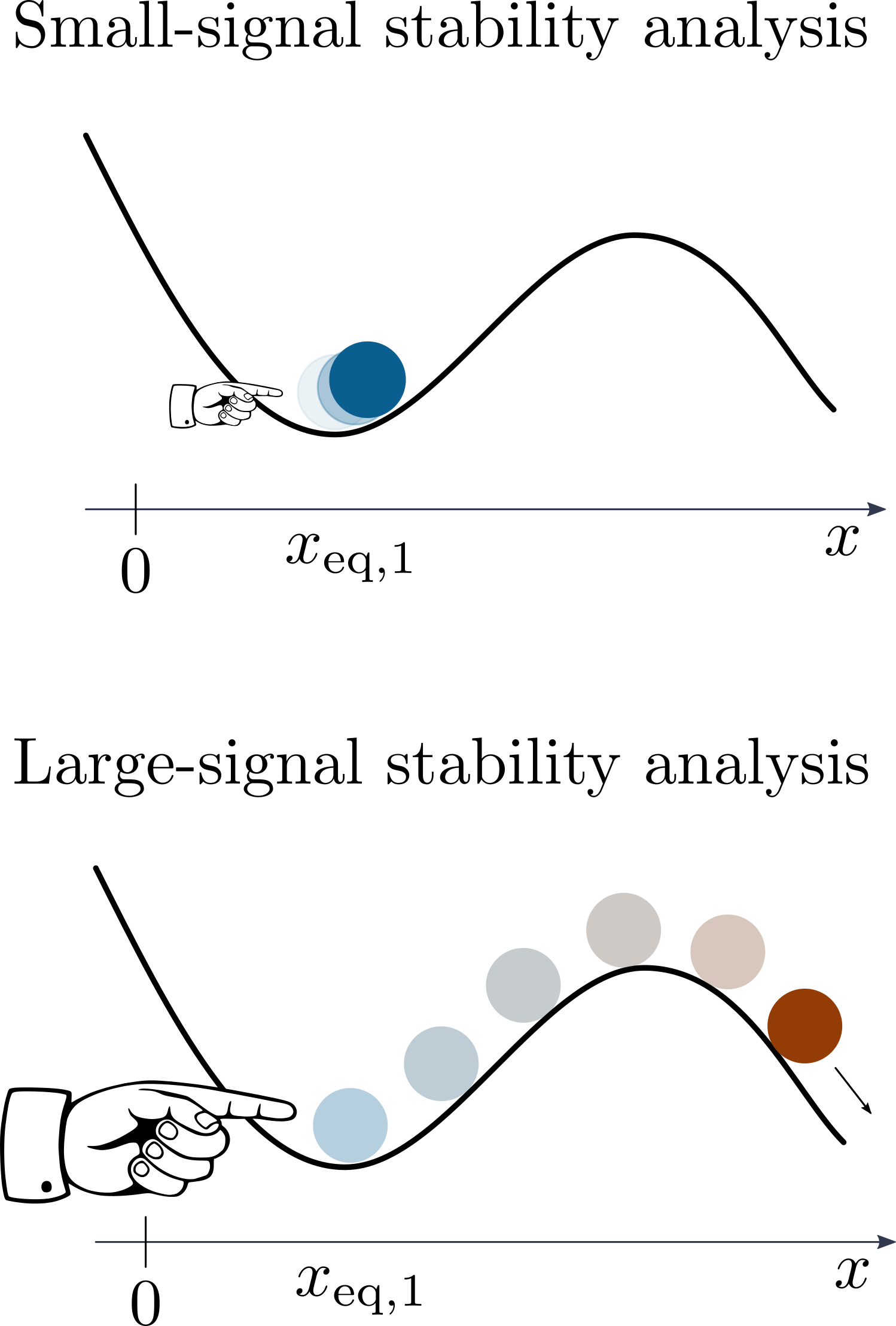
This course covers fundamental notions of stability from a controls engineering and system-theoretic viewpoint. Foundational elements related to small-signal and large-signal stability are over viewed adopting a technology agnostic lens. Models and modeling paradigms to facilitate analytical stability assessment at different timescales are presented. Representation of system dynamics in state-space and in the frequency domain will follow, with a discussion on how stability is examined in each. Taking a step closer to practice, frequency domain conditions for GFM IBR standards and stability under interconnection will be presented next. This will bridge the gap from academic treatments and analytical approaches to how grid codes can facilitate stability-enforcing operation of grid-forming technologies.

Course length: 5 sessions, 2 hours each, 4 modules. Total duration 10 hours.

Course includes: Lecture slides (sample below), pen-&-paper exercises, short quizzes, and simulations

Last offered: Fall 2026

Module 1

This module provides an overview of the concept of stability, and why this is an important concept in the device- and system-level analysis and design of grid-forming (and other grid-connected) technologies. Real-world instances of instability spanning oscillations and tripping are utilized to motivate the need for systematic small- and large-signal stability assessment of nonlinear dynamics associated with grid-forming technologies. Challenges in performing stability assessment across scales are discussed. EMT Exercise: A single unit infinite bus is subjected to various disturbances to demonstrate the role of stability-focused designs in ensuring robustness.

Module 2

As a first step in studying stability, we begin with small-signal stability. An introduction to the notion is provided from the context of general nonlinear dynamical systems. Upon motivating challenges in computational and analytical stability assessment, GFM model abstractions that facilitate stability assessment are introduced. Detailed small-signal stability analysis of a second-order grid-forming droop / virtual synchronous machine based model concludes the module. Simulation Exercise: Code- and EMT simulation exercises demonstrate how one determines eigenvalues and impact of design choices on a prototypical second-order GFM model. Numerical approach to obtain eigenvalues of higher-order GFM model.

Module 3

This module transitions to focus on large-signal stability. We begin with motivating why this notion is challenging to study given the nonlinearities involved in system dynamical models and also why it is important to examine in spite of challenges involved. Notions of region-of-attraction and Lyapunov stability are introduced. An analytical approach to obtain the region-of-attraction of the second-order grid-forming droop / virtual synchronous machine based model is presented. Technical concepts including definiteness of matrices, manipulations of ellipsoids, and linear matrix inequalities are discussed. Challenges and solutions to factor in current limiters are presented.

Module 4

The final module focuses on input-output models for grid-forming inverters and characterizing stability in the frequency domain with a pathway towards grid codes. We begin with introducing fundamental notions of passivity, Bode plots, how to infer dynamic performance by examining Bode plots, and how time-domain specifications (frequently found in codes) can be conceptualized in the frequency domain. Dynamic droop models for grid-forming inverters are introduced in the frequency domain. Real-world examples of frequency-domain specifications in action, experimental setups to obtain input-output models, and the path forward to development of standards and grid codes with precise quantifiable measures are discussed. 

Testimonials

"Really loved the slide animations to help visualize the concepts; keep up the good work there!"

"I liked the multiple instructor format and teh interjections from the different instructors, it prevents the monotone format of having one instructor. I also liked the summaries after each section to distill the main take aways."

"Truly the course I found is very interesting. The way topics are covered is very smooth."

"This course was amazing! From the slides, animations, MATLAB exercises, and quizzes, everything built off each other to illustrate the fundamentals of small -signal and large -signal stability."